

 |
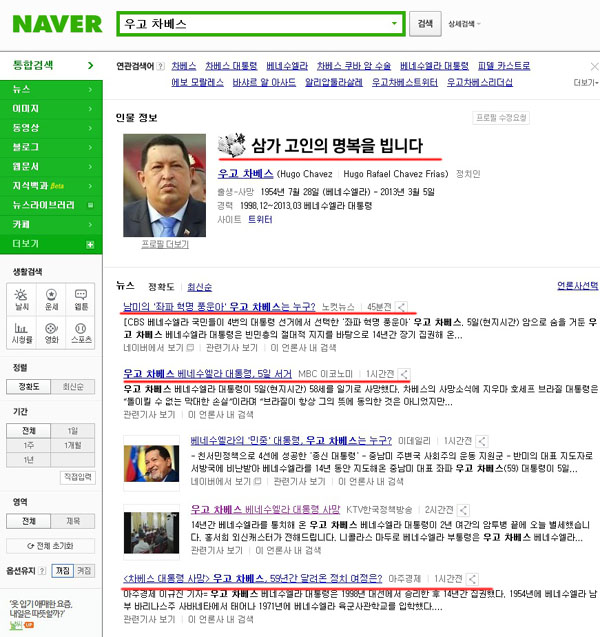
■ 남아메리카의 반미좌익(反美左翼) 우고 차베스의 사망 이후 親盧 포털 <네이버>에서 검색어로 '우고 차베스'를 쳐 보았다. 그러자 <네이버> 인물정보란에 '삼가 고인의 명복을 빕니다'라며 차베스의 죽음을 애도하는 문구가 떴다. 뉴스란의 각 언론사의 차베스 사망 관련 제목을 확인해 보았다. 하나같이 차베스의 죽음을 마음 깊이 애도하는 듯한 제목 일색이다.
1. 노컷뉴스: <'남미의 좌파 혁명 풍운아' 우고 차베스는 누구?>
2. MBC 이코노미: 우고 차베스 베네수엘라 대통령, 5일 서거
3. 이데일리: 베네수엘라의 '민중' 대통령, 우고 차베스는 누구?
4. 아주경제: <차베스 대통령 사망> 우고 차베스, 59년간 달려온 정치 여정은?
................ (이하생략)
차베스는 1999년 집권 이후 14년간 베네수엘라를 통치하면서 左翼정당을 이끌며 미국이 주도하는 新자유주의에 반대하는 정책을 펼쳐왔다.
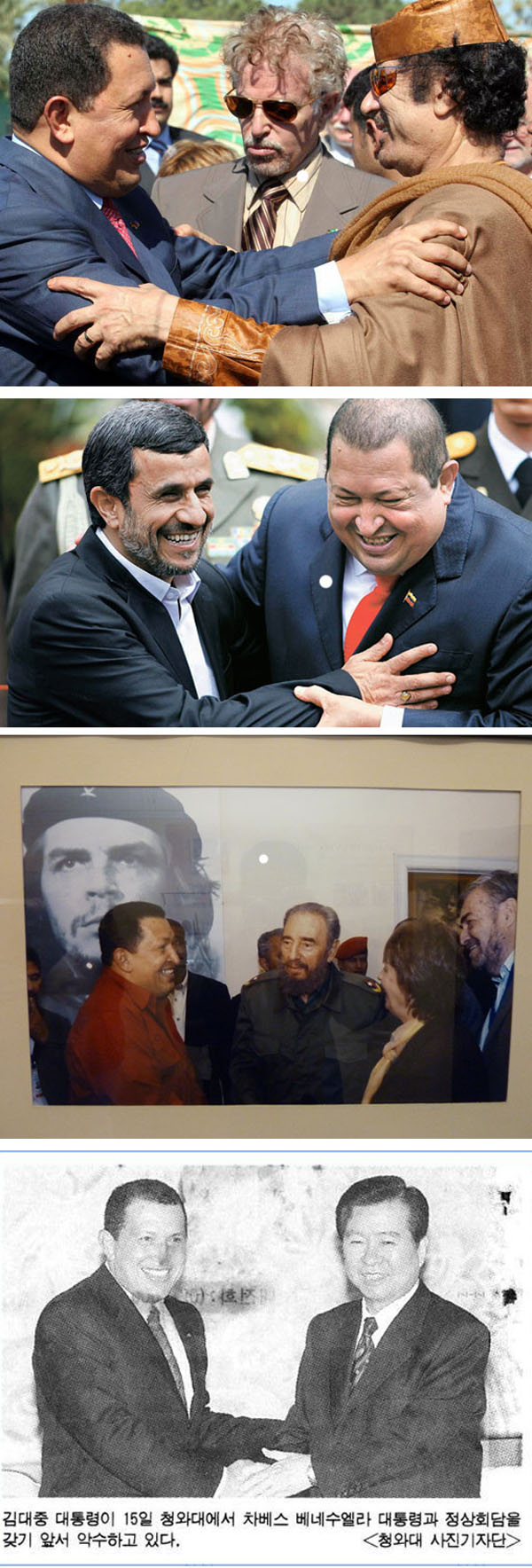
한국과의 관계는 1999년 방한해 김대중과 정상회담을 가졌고, 국내 모 대학으로부터 명예박사학위를 받았다. 이후 지독한 反美 성향과 장기 집권으로 관계가 소원해졌다. 대신 독재집단인 북한과 우호적 관계를 유지했다. 2011년 북한 독재자 김정일이 사망하자, 라틴 아메리카 국가 정상으로서는 유일하게 공식적으로 애도를 표명했다.
저서로는 사회주의적 개혁정치를 연구한 ‘차베스, 미국과 맞짱뜨다’, ‘베네수엘라 혁명모임, 시대의 창’이 있다.
■ 미국의 뉴욕타임지(NYT) 보도에 따르면 베네수엘라의 살인률은 이라크보다 훨씬 높은 것으로 조사됐다. NYT는 2010년 남미 국가들의 범죄 통계를 기초로 기사를 보도했다.
2009년 이라크에서는 4,644명이 사망했고 같은 기간 베네수엘라에서는 16000명이 사망했다. 흥미로운 사실은 양국의 인구는 2800만 명으로 동일했다.
베네수엘라 일간지 ‘El Nacional’의 경우 수도인 카라카스에 즐비하게 늘어서 있는 시체를 담은 사진을 게재하며 국가치안의 취약을 고발하기도 했다.
차베스가 대통령으로 취임한 1999년 이래 베네수엘라에서는 118,541건의 살인이 발생했다. 2007년~2010년 기간 동안 43,792건의 살인이 발생했다.(인터넷 <남미로닷컴>, 2010년 8월26일자 보도 인용)
베네수엘라 중심대학의 사회학자 겸 범죄연구소장인 로베르또 브리세노 레온은 베네수엘라의 살인률이 차베스가 취임한 이후 3배로 늘어났다고 말했다.
그는 경제실적도 좋지 않아 사회 불균등이 계속 유지되고 있어 살인률이 점점 증가하고 있다고 밝혔다. 그러나 차베스 대통령의 정책 때문에 범죄가 늘어났다고는 말하지 않았다.
한국의 변태적 좌(左)편향 언론들은 베네수엘라의 이런 문제는 눈에 보이지도 않는다. 오로지 차베스가 생전에 反美노선을 걸었기 때문에 友軍으로 생각하는 듯하다.
조갑제닷컴 김필재 spooner1@hanmail.net
 |
[관련자료] Venezuela, More Deadly Than Iraq, Wonders Why
By SIMON ROMERO
Published: August 22, 2010
CARACAS, Venezuela — Some here joke that they might be safer if they lived in Baghdad. The numbers bear them out
In Iraq, a country with about the same population as Venezuela, there were 4,644 civilian deaths from violence in 2009, according to Iraq Body Count in Venezuela that year, the number of murders climbed above 16,000.
Even Mexico’s infamous drug war has claimed fewer lives.
Venezuelans have absorbed such grim statistics for years. Those with means have hidden their homes behind walls and hired foreign security experts to advise them on how to avoid kidnappings and killings. And rich and poor alike have resigned themselves to living with a murder rate that the opposition says remains low on the list of the government’s priorities.
Then a front-page photograph in a leading independent newspaper — and the government’s reaction — shocked the nation, and rekindled public debate over violent crime.
The photo in the paper, El Nacional, is unquestionably gory. It shows a dozen homicide victims strewn about the city’s largest morgue, just a sample of an unusually anarchic two-day stretch in this already perilous place.
While many Venezuelans saw the picture as a sober reminder of their vulnerability and a chance to effect change, the government took a different stand.
A court ordered the paper to stop publishing images of violence, as if that would quiet growing questions about why the government — despite proclaiming a revolution that heralds socialist values — has been unable to close the dangerous gap between rich and poor and make the country’s streets safer.
“Forget the hundreds of children who die from stray bullets, or the kids who go through the horror of seeing their parents or older siblings killed before their eyes,” said Teodoro Petkoff, the editor of another newspaper here, mocking the court’s decision in a front-page editorial. “Their problem is the photograph.”
Venezuela is struggling with a decade-long surge in homicides, with about 118,541 since President Hugo Chávez took office in 1999, according to the Venezuelan Violence Observatory, a group that compiles figures based on police files. (The government has stopped publicly releasing its own detailed homicide statistics, but has not disputed the group’s numbers, and news reports citing unreleased government figures suggest human rights groups may actually be undercounting murders).
There have been 43,792 homicides in Venezuela since 2007, according to the violence observatory, compared with about 28,000 deaths from drug-related violence in Mexico since that country’s assault on cartels began in late 2006.
Caracas itself is almost unrivaled among large cities in the Americas for its homicide rate, which currently stands at around 200 per 100,000 inhabitants, according to Roberto Briceño-León, the sociologist at the Central University of Venezuela who directs the violence observatory.
That compares with recent measures of 22.7 per 100,000 people in Bogotá, Colombia’s capital, and 14 per 100,000 in São Paulo, Brazil’s largest city. As Mr. Chávez’s government often points out, Venezuela’s crime problem did not emerge overnight, and the concern over murders preceded his rise to power.
But scholars here describe the climb in homicides in the past decade as unprecedented in Venezuelan history the number of homicides last year was more than three times higher than when Mr. Chávez was elected in 1998.
Reasons for the surge are complex and varied, experts say. While many Latin American economies are growing fast, Venezuela’s has continued to shrink. The gap between rich and poor remains wide, despite spending on anti-poverty programs, fueling resentment. Adding to that, the nation is awash in millions of illegal firearms.
Police salaries remain low, sapping motivation. And in a country with the highest inflation rate in the hemisphere, more than 30 percent a year, some officers have turned to supplementing their incomes with crimes like kidnappings.
But some crime specialists say another factor has to be considered: Mr. Chávez’s government itself. The judicial system has grown increasingly politicized, losing independent judges and aligning itself more closely with Mr. Chávez’s political movement. Many experienced state employees have had to leave public service, or even the country.
More than 90 percent of murders go unsolved, without a single arrest, Mr. Briceño-León said. But cases against Mr. Chavez’s critics — including judges, dissident generals and media executives — are increasingly common.
Henrique Capriles, the governor of Miranda, a state encompassing parts of Caracas, told reporters last week that Mr. Chávez had worsened the homicide problem by cutting money for state and city governments led by political opponents and then removing thousands of guns from their police forces after losing regional elections.
But the government says it is trying to address the problem. It recently created a security force, the Bolivarian National Police, and a new Experimental Security University where police recruits get training from advisers from Cuba and Nicaragua, two allies that have historically maintained murder rates among Latin America’s lowest.
The national police’s overriding priority, said Víctor Díaz, a senior official on the force and an administrator at the new university, is “unrestricted respect for human rights.”
“I’m not saying we’ll be weak,” he said, “but the idea is to use dialogue and dissuasion as methods of verbal control when approaching problems.”
Senior officials in Mr. Chávez’s government say the deployment of the national police, whose ranks number fewer than 2,500, has succeeded in reducing homicides in at least one violent area of Caracas where they began patrolling this year.
Still, human rights groups suggest the new policing efforts have been far too timid. Incosec, a research group here that focuses on security issues, counted 5,962 homicides in just 10 of Venezuela’s 23 states in the first half of this year.
Meanwhile, the debate over the morgue photograph published by El Nacional is intensifying, evolving into a broader discussion over the government’s efforts to clamp down on the news outlets it does not control.
The government says the photograph was meant to undermine it, not to inform the public. The authorities are also threatening an inquiry into “Rotten Town,” a video by a Venezuelan reggae singer that shows an innocent child struck down by a stray bullet. For all the government’s protests, the video has spread rapidly across the Internet since its release here this month.
Given the government’s stance in these cases, many here worry it is focusing on the messenger, not the underlying message.
Hector Olivares, 47, waited outside the morgue early one morning this month to recover the body of his son, also named Hector, 21. He said his son was at a party in the slum of El Cercado, on the outskirts of Caracas, when a gunman opened fire.
Mr. Olivares said Hector was the second son he had lost in a senseless murder, after another son was killed four years ago at the age of 22. He said he did not blame Mr. Chávez for the killings, but he pleaded with the president to make combating crime a higher priority.
“We elected him to crack down on the problems we face,” he said. “But there’s no control of criminals on the street, no control of anything.”
María Eugenia Díaz contributed reporting.
A version of this article appeared in print on August 23, 2010, on page A1 of the New York edition.